Tell us about the job
Takes about a minute. No obligation.
A compressor that sat off through fall, winter, and spring and then started hard on the first July afternoon is carrying a different kind of stress than one that wears down over months of steady cycling. Homes in Capitol Planning Region, CT run cooling about two months a year, from July through August. Contactors corrode during long idle periods, capacitors drift, and refrigerant issues that developed in storage go unnoticed until the system is actually called on. A contractor diagnosing a central AC failure here checks start components and electrical connections before assuming the compressor itself is done, because dormancy failures and wear failures point to different repairs and different costs.
Ductwork in a house this old has already been adapted more than once, and the Central AC unit a contractor opens today is rarely the original. Half the homes in Capitol Planning Region, Connecticut were built in 1966 or earlier (2020-2024 ACS 5-year). What that history produces, in practice, is a repair where the diagnosis is straightforward but sourcing is not: components a system of this age requires are sometimes out of production, and a contractor has to confirm availability before a repair scope can be priced accurately. That gap between what the system needs and what a supplier still stocks is where repairs in this region take longer than the fault itself would suggest.
The Parts of a Central AC a Contractor Checks First
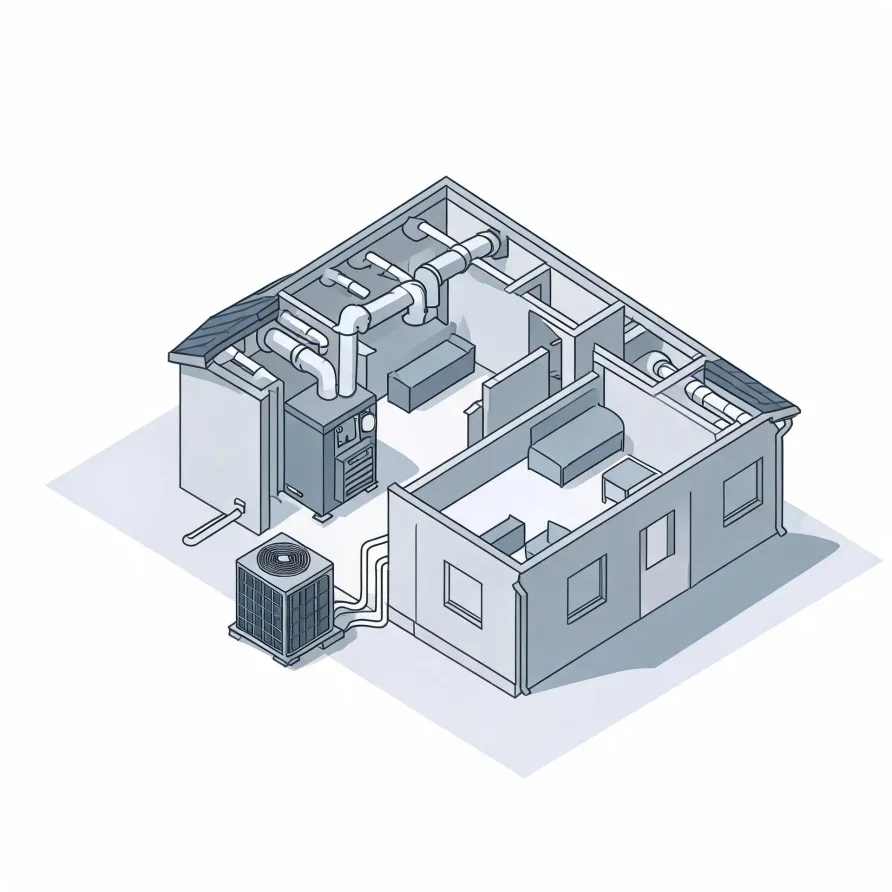
The outdoor condenser unit sits on a concrete pad outside the house and holds the compressor and condenser coil, the two components a contractor reaches for first when the system stops cooling. The compressor is the heart of the refrigerant circuit, and a failed one is often what turns a repair call into a bigger conversation. The condenser coil sheds heat to the outside air, and a damaged or blocked coil shows up quickly in how the system performs.
Inside the house, the air handler or furnace cabinet holds the evaporator coil and the blower, with the evaporator coil sitting directly above the heat exchanger in the airstream where it pulls heat from indoor air. The blower pushes that air across the coil and through the house. The refrigerant lines that run between the two units and the expansion valve that controls refrigerant flow are also on a contractor's checklist, since a leak or a stuck valve can mimic the symptoms of a failed compressor or coil.
The drawing shows the general layout of a central AC system, and a licensed contractor determines which components apply and what the work involves in your particular house.
Find a contractor in Capitol Planning RegionCapitol Planning Region by the numbers
Half the homes in Capitol Planning Region, Connecticut were built in 1966 or earlier (2020-2024 ACS 5-year).
U.S. Census Bureau, 2020-2024 American Community Survey 5-Year EstimatesCapitol Planning Region, Connecticut holds 416,559 housing units (2020-2024 ACS 5-year).
U.S. Census Bureau, 2020-2024 American Community Survey 5-Year EstimatesOwners occupy 65.7% of the occupied homes in Capitol Planning Region, Connecticut (2020-2024 ACS 5-year).
U.S. Census Bureau, 2020-2024 American Community Survey 5-Year EstimatesRules & Standards Governing Central AC Repair in Capitol Planning Region, Connecticut9 sourced rules and standards
What HVAC Repair Looks Like in Capitol Planning Region
Split-system central air conditioners rated below 45,000 Btu/h manufactured on or after January 1, 2023 must meet a federal minimum of 13.4 SEER2.
Split-system central air conditioners rated at or above 45,000 Btu/h manufactured on or after January 1, 2023 must meet a federal minimum of 13.4 SEER2.
Split-system central air conditioners manufactured between January 1, 2015 and December 31, 2022 had to meet 13 SEER, the metric that preceded SEER2.
Single-package central air conditioners manufactured on or after January 1, 2023 must meet a federal minimum of 13.4 SEER2.
Space-constrained central air conditioners manufactured on or after January 1, 2023 must meet a federal minimum of 11.7 SEER2.
Federal efficiency standards for split-system central air conditioners and heat pumps are set on each certified combination of outdoor unit and indoor coil rather than on the outdoor unit alone.
Residential and light commercial air conditioning and heat pump systems assembled in the field, including mini-splits and unitary systems, may not be installed on or after January 1, 2025 using a refrigerant with a global warming potential above 700.
A field-assembled system whose specified components were all manufactured or imported before January 1, 2025 carries no installation compliance date under the refrigerant restrictions and may still be installed.
Licensing Rules for HVAC Repair in Capitol Planning Region, Connecticut
Connecticut requires a state licence to perform, or to advertise, heating, piping and cooling work: no person may practise an occupation this chapter covers without first obtaining one.