Tell us about the job
Takes about a minute. No obligation.
A compressor that runs a compressed cooling window and then sits idle for the rest of the year does not accumulate wear evenly. Homes in Lower Connecticut River Valley Planning Region, CT run cooling about two months a year, from July through August. Contactor contacts, capacitors, and condenser fan motors that cycled hard through July and August can degrade quietly during the long off period, and the failure only shows when a homeowner switches the system on the following summer. A contractor diagnosing a repair here checks those components before writing a quote, because a unit that ran without complaint last season can arrive at the next startup already failing.
Ductwork that has carried multiple systems over the decades tends to hide its own condition until a contractor is already inside the job. Half the homes in Lower Connecticut River Valley Planning Region, Connecticut were built in 1972 or earlier (2020-2024 ACS 5-year). That means a repair call here regularly turns up refrigerant lines, coil housings, or control boards sized for equipment generations that manufacturers have largely stopped supporting. A contractor who opens a unit in this region prices the job from what is physically in front of them, because the parts a system this age requires are not always on a distributor's shelf.
The Parts of a Central AC a Contractor Checks First
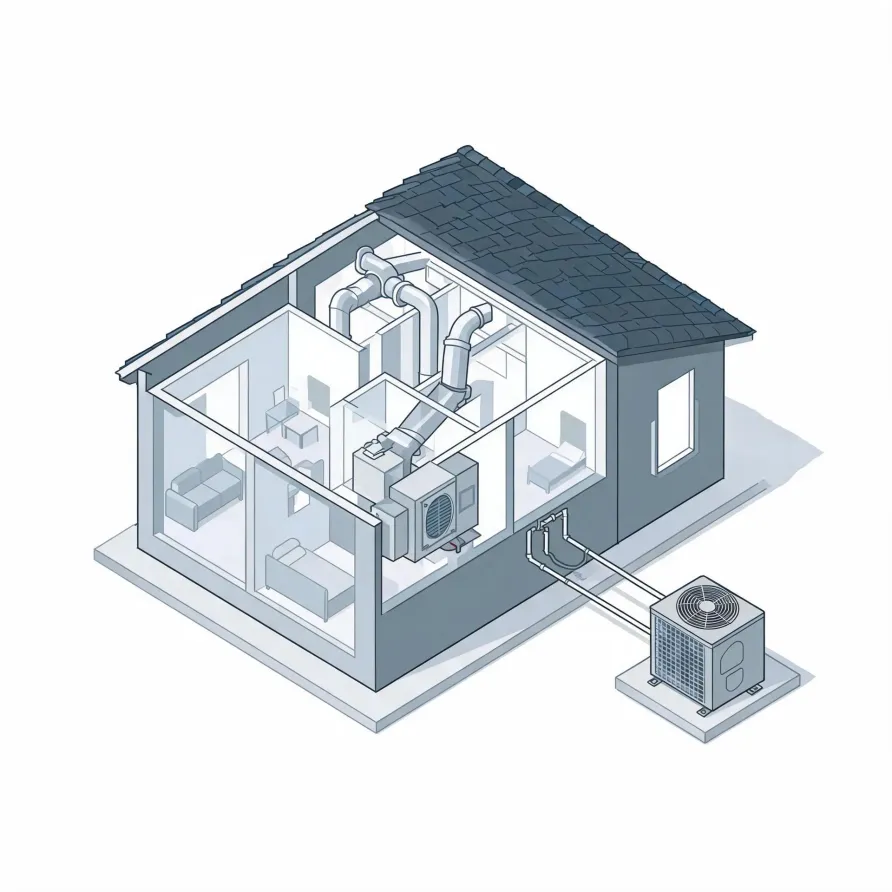
The outdoor condenser unit sits outside the house, usually on a concrete pad along an exterior wall, and it is where the system sheds heat to the outside air. The indoor air handler or furnace-mounted evaporator coil sits inside, often in a basement, utility closet, or attic, and it is where the refrigerant absorbs heat from your indoor air. When either of these is the problem, the symptoms show up fast: the house stops cooling, or the unit runs without doing much at all.
The refrigerant lines are the copper tubes that run between the two units, and a leak anywhere along them throws off the whole system. The expansion valve and the capacitors, contactors, and fan motors that live inside both cabinets are the pieces a contractor pulls out and tests when the bigger components check out fine.
The drawing shows a typical layout, and a licensed contractor determines which components and conditions apply to this particular house.
Find a contractor in Lower Connecticut River Valley Planning RegionLower Connecticut River Valley by the Numbers
Half the homes in Lower Connecticut River Valley Planning Region, Connecticut were built in 1972 or earlier (2020-2024 ACS 5-year).
U.S. Census Bureau, 2020-2024 American Community Survey 5-Year EstimatesLower Connecticut River Valley Planning Region, Connecticut holds 82,963 housing units (2020-2024 ACS 5-year).
U.S. Census Bureau, 2020-2024 American Community Survey 5-Year EstimatesOwners occupy 75.8% of the occupied homes in Lower Connecticut River Valley Planning Region, Connecticut (2020-2024 ACS 5-year).
U.S. Census Bureau, 2020-2024 American Community Survey 5-Year EstimatesRules & Standards for Central AC Repair in Lower Connecticut River Valley Planning Region, Connecticut9 sourced rules and standards
What HVAC Repair Looks Like in Lower Connecticut River Valley
Split-system central air conditioners rated below 45,000 Btu/h manufactured on or after January 1, 2023 must meet a federal minimum of 13.4 SEER2.
Split-system central air conditioners rated at or above 45,000 Btu/h manufactured on or after January 1, 2023 must meet a federal minimum of 13.4 SEER2.
Split-system central air conditioners manufactured between January 1, 2015 and December 31, 2022 had to meet 13 SEER, the metric that preceded SEER2.
Single-package central air conditioners manufactured on or after January 1, 2023 must meet a federal minimum of 13.4 SEER2.
Space-constrained central air conditioners manufactured on or after January 1, 2023 must meet a federal minimum of 11.7 SEER2.
Federal efficiency standards for split-system central air conditioners and heat pumps are set on each certified combination of outdoor unit and indoor coil rather than on the outdoor unit alone.
Residential and light commercial air conditioning and heat pump systems assembled in the field, including mini-splits and unitary systems, may not be installed on or after January 1, 2025 using a refrigerant with a global warming potential above 700.
A field-assembled system whose specified components were all manufactured or imported before January 1, 2025 carries no installation compliance date under the refrigerant restrictions and may still be installed.
Licensing Rules for HVAC Repair in Lower Connecticut River Valley Planning Region, Connecticut
Connecticut requires a state licence to perform, or to advertise, heating, piping and cooling work: no person may practise an occupation this chapter covers without first obtaining one.