Tell us about the job
Takes about a minute. No obligation.
A contractor quoting central AC installation in Northwest Hills has to size the system for a load the house will only ask for once a year. Homes in Northwest Hills Planning Region, CT run cooling in a single month of the year, July. The compressor, condenser fan, and contactor carry that entire seasonal demand in a single concentrated stretch, so a unit that is undersized or poorly matched to the home's envelope runs harder than it should through every hour it operates. Ductwork leaks and coil mismatches that a longer season might reveal gradually will instead hide until the next July arrives and the same problems return.
Existing ductwork is what a central AC installation in Northwest Hills Planning Region turns on. Half the homes in Northwest Hills Planning Region, Connecticut were built in 1967 or earlier (2020-2024 ACS 5-year). That puts a large share of the housing stock in a period when duct layouts were sized and routed for systems whose load profiles bear little resemblance to what a contractor is dropping in now. A new unit can be spec'd quickly; whether the ducts behind the walls will carry it at the right static pressure is what the job actually waits on. A contractor here measures and tests the existing system before committing to a design, because the ductwork is where the answer lives.
What Gets Installed With a New Central AC
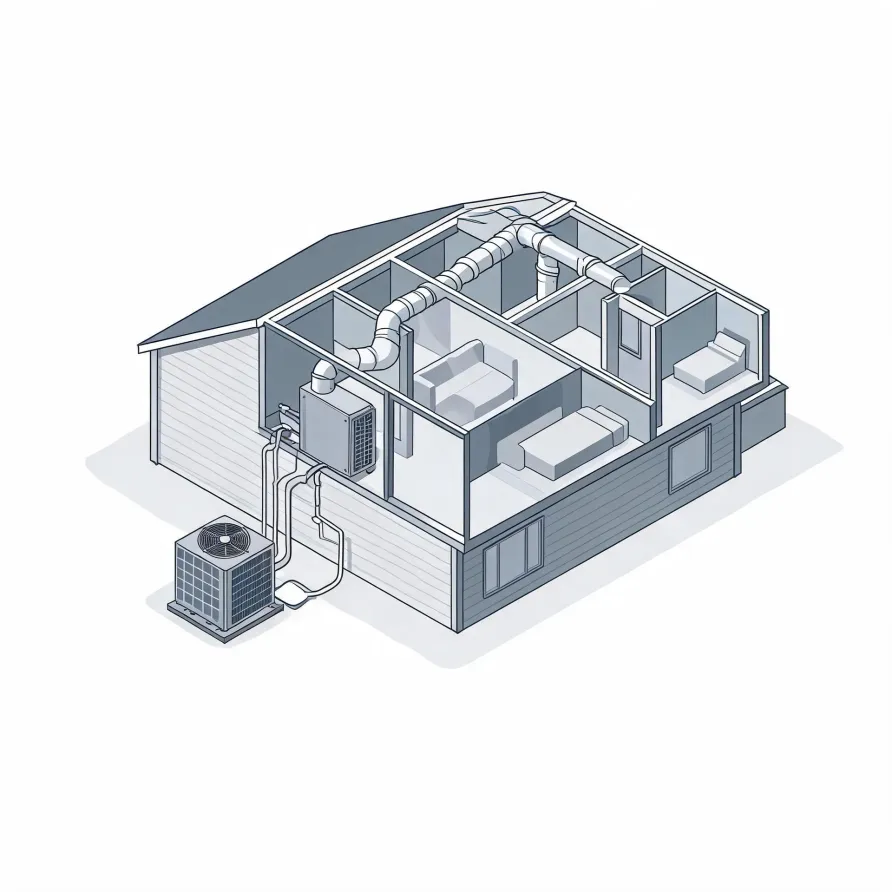
The outdoor condenser unit sits outside the house, usually on a concrete pad along a side or rear wall, and it holds the compressor and condenser coil. Inside, the air handler or furnace-mounted evaporator coil sits in a utility space, basement, or closet, and it is the indoor half of the system. Together these two units form the installed equipment.
The refrigerant line set runs between the outdoor and indoor units, carrying refrigerant through insulated copper tubing that passes through an exterior wall. A thermostat mounts on an interior wall and gives the homeowner control over when the system runs. A condensate drain line also runs from the indoor coil to a suitable drain, carrying away the moisture the coil pulls from the air.
The drawing shows a typical layout, and a licensed contractor determines exactly how each piece fits the setup in your house.
Find a contractor in Northwest Hills Planning RegionNorthwest Hills by the Numbers
Half the homes in Northwest Hills Planning Region, Connecticut were built in 1967 or earlier (2020-2024 ACS 5-year).
U.S. Census Bureau, 2020-2024 American Community Survey 5-Year EstimatesNorthwest Hills Planning Region, Connecticut holds 55,752 housing units (2020-2024 ACS 5-year).
U.S. Census Bureau, 2020-2024 American Community Survey 5-Year EstimatesOwners occupy 76.3% of the occupied homes in Northwest Hills Planning Region, Connecticut (2020-2024 ACS 5-year).
U.S. Census Bureau, 2020-2024 American Community Survey 5-Year EstimatesCodes & Standards Governing Central AC Installation in Northwest Hills Planning Region, Connecticut9 sourced rules and standards
What HVAC Installation Looks Like in Northwest Hills
Split-system central air conditioners rated below 45,000 Btu/h manufactured on or after January 1, 2023 must meet a federal minimum of 13.4 SEER2.
Split-system central air conditioners rated at or above 45,000 Btu/h manufactured on or after January 1, 2023 must meet a federal minimum of 13.4 SEER2.
Split-system central air conditioners manufactured between January 1, 2015 and December 31, 2022 had to meet 13 SEER, the metric that preceded SEER2.
Single-package central air conditioners manufactured on or after January 1, 2023 must meet a federal minimum of 13.4 SEER2.
Space-constrained central air conditioners manufactured on or after January 1, 2023 must meet a federal minimum of 11.7 SEER2.
Federal efficiency standards for split-system central air conditioners and heat pumps are set on each certified combination of outdoor unit and indoor coil rather than on the outdoor unit alone.
Residential and light commercial air conditioning and heat pump systems assembled in the field, including mini-splits and unitary systems, may not be installed on or after January 1, 2025 using a refrigerant with a global warming potential above 700.
A field-assembled system whose specified components were all manufactured or imported before January 1, 2025 carries no installation compliance date under the refrigerant restrictions and may still be installed.
Licensing and Legal Requirements in Northwest Hills Planning Region, Connecticut
Connecticut requires a state licence to perform, or to advertise, heating, piping and cooling work: no person may practise an occupation this chapter covers without first obtaining one.