Tell us about the job
Takes about a minute. No obligation.
Sizing a central AC system here starts with understanding exactly what the compressor is asked to do each year. Homes in South Central Connecticut Planning Region, CT run cooling about two months a year, from July through August. The compressor, the condenser fan, and the contactor all spend the bulk of the calendar off, and components that sit idle for long stretches can corrode, seize, or fail in ways that running equipment would signal sooner. A contractor quoting an installation has to account for that idle time when selecting equipment and specifying how it is commissioned, because a unit that starts reliably after a long dormant period is a different conversation than one that simply runs well mid-season.
Ductwork laid down for one generation of equipment rarely fits the next one without modification. Half the homes in South Central Connecticut Planning Region, Connecticut were built in 1964 or earlier (2020-2024 ACS 5-year). A contractor sizing a new central AC system here has to assess what those existing ducts can actually carry, and whether the electrical service has the capacity the new unit draws, before a quote means anything. Houses where neither has been touched since the original install often need both looked at. The ductwork is where the scope of the job is decided.
What Gets Installed With a New Central AC
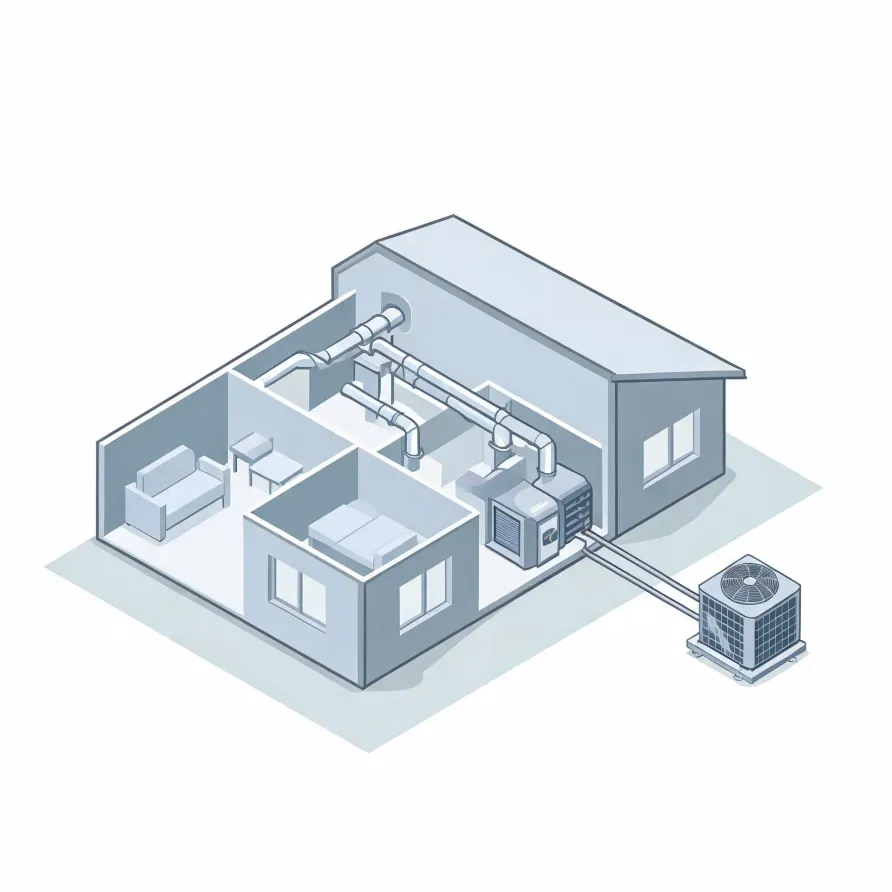
The outdoor condenser unit sits outside the house, usually on a concrete pad at ground level, and holds the compressor and condenser coil. Inside, the air handler mounts in a basement, closet, or utility space and contains the evaporator coil and blower that move conditioned air through the home.
The thermostat goes on an interior wall where it reads the air temperature of the living space and signals the system to run. A condensate drain line runs from the air handler to a floor drain or outside, carrying away the moisture the evaporator coil pulls from the air.
The drawing shows a typical layout, and a licensed contractor determines exactly what fits and where in your house.
Find a contractor in South Central Connecticut Planning RegionSouth Central Connecticut Planning Region, by the numbers
Half the homes in South Central Connecticut Planning Region, Connecticut were built in 1964 or earlier (2020-2024 ACS 5-year).
U.S. Census Bureau, 2020-2024 American Community Survey 5-Year EstimatesSouth Central Connecticut Planning Region, Connecticut holds 248,267 housing units (2020-2024 ACS 5-year).
U.S. Census Bureau, 2020-2024 American Community Survey 5-Year EstimatesOwners occupy 60.5% of the occupied homes in South Central Connecticut Planning Region, Connecticut (2020-2024 ACS 5-year).
U.S. Census Bureau, 2020-2024 American Community Survey 5-Year EstimatesCodes & Standards Governing Central AC Installation in South Central Connecticut Planning Region, Connecticut9 sourced rules and standards
What the Installation Actually Looks Like
Split-system central air conditioners rated below 45,000 Btu/h manufactured on or after January 1, 2023 must meet a federal minimum of 13.4 SEER2.
Split-system central air conditioners rated at or above 45,000 Btu/h manufactured on or after January 1, 2023 must meet a federal minimum of 13.4 SEER2.
Split-system central air conditioners manufactured between January 1, 2015 and December 31, 2022 had to meet 13 SEER, the metric that preceded SEER2.
Single-package central air conditioners manufactured on or after January 1, 2023 must meet a federal minimum of 13.4 SEER2.
Space-constrained central air conditioners manufactured on or after January 1, 2023 must meet a federal minimum of 11.7 SEER2.
Federal efficiency standards for split-system central air conditioners and heat pumps are set on each certified combination of outdoor unit and indoor coil rather than on the outdoor unit alone.
Residential and light commercial air conditioning and heat pump systems assembled in the field, including mini-splits and unitary systems, may not be installed on or after January 1, 2025 using a refrigerant with a global warming potential above 700.
A field-assembled system whose specified components were all manufactured or imported before January 1, 2025 carries no installation compliance date under the refrigerant restrictions and may still be installed.
Licensing Rules for South Central Connecticut Planning Region, Connecticut
Connecticut requires a state licence to perform, or to advertise, heating, piping and cooling work: no person may practise an occupation this chapter covers without first obtaining one.